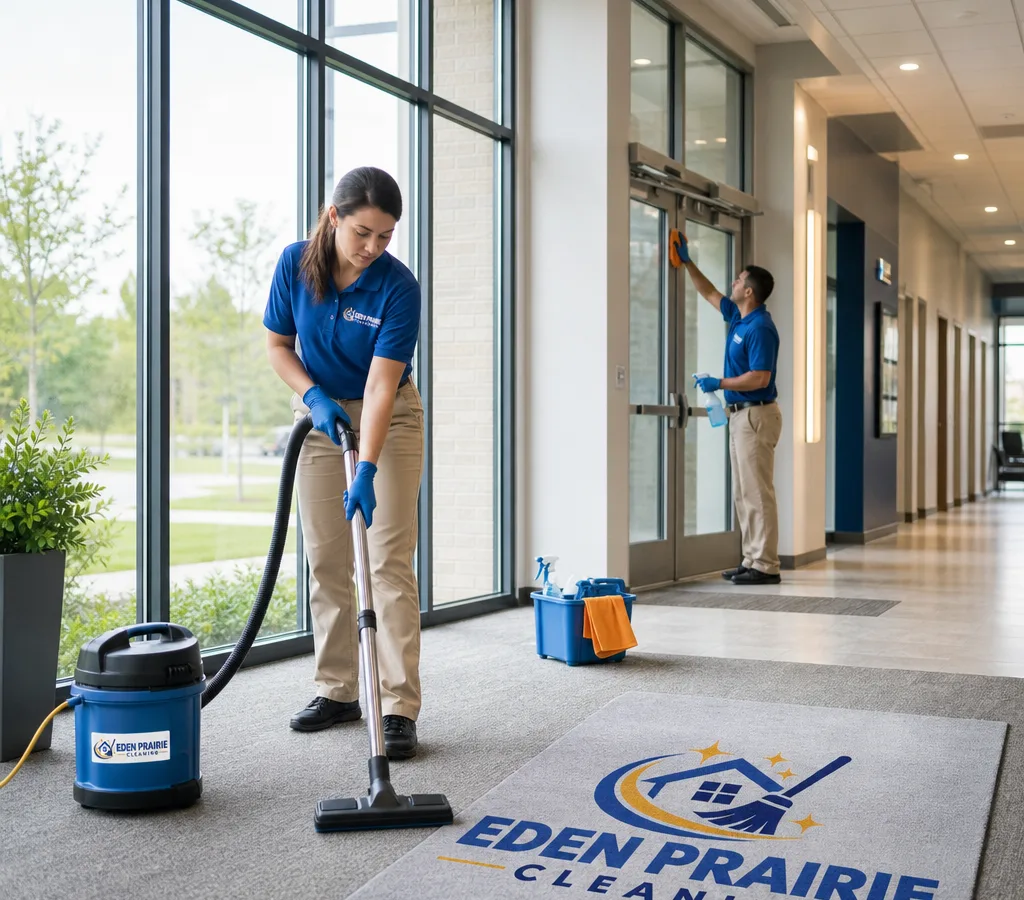
Professional cleaning in a modern Eden Prairie office lobby and corridor

Janitorial services, Eden Prairie

Janitorial Services in Eden Prairie

A contracted program rather than a visit: a written scope, a frequency against every task, supplies accounted for, and checks that catch a miss before your staff do.

✓Written scopes ✓Documented tasks ✓Flexible scheduling ✓Ongoing quality checks

A program, not a visit

What a janitorial contract actually commits to

Janitorial service is a staffing and supply commitment measured over months, and the questions that decide whether it works are about coverage. Who cleans the building on a given night, what happens when that person is out, who notices the towels are low before staff do, and how a missed task gets corrected without a phone call every week.

That is why the document matters more than the checklist. Every task carries a frequency: nightly, a set number of nights each week, weekly, monthly, or quarterly. Restrooms and waste sit on the short cycle, while high dusting, vents, and hard floor restoration sit on the long one and still have to be scheduled rather than promised.

  • Consistency: the same scope, the same standards, and documented tasks.
  • Practical scheduling: after-hours, early morning, or daytime touch-ups where appropriate.
  • Building-ready cleaning: methods and products suited for common office finishes like LVT, VCT, carpet tile, glass, stainless, and painted drywall.

Facilities around here are not all offices either. Light industrial bays, warehouse and shop space, showrooms, studio and fitness space, and multi tenant buildings each need a different task list, even when the schedule on paper looks the same. We build the list from the building rather than from a template.

For a broader look at what we do across properties beyond office spaces, review our cleaning services in Eden Prairie.

A program, not a visit

What a janitorial contract actually commits to

A written scope with a frequency per task

Every area and every task listed with how often it happens, plus what is explicitly excluded: locked rooms, personal items, equipment surfaces, tenant spaces. An unambiguous scope is what makes the result repeatable across different nights and different crews.

Restroom cycles and consumable supply

Fixture count and daily traffic set the cycle, not the room count. Dispensers get checked and restocked on the same visit rather than when someone complains, and usage over the first weeks tells us the real consumption rate to plan around.

Waste streams staged your way

Landfill, recycling, and anything your building handles separately, collected on the frequency each stream needs and staged where your property manager requires. Liner sizes, collection points, and dock or closet rules get recorded once and followed.

Floor care planned across the year

Daily vacuuming and mopping is maintenance, not floor care. Hard floor and carpet work belongs on a calendar: more frequent entry attention through the salt months, scheduled deeper work in the quieter parts of your year.

Coverage when someone is out

A program is only as good as its worst week. The scope states who covers an absence, how a substitute gets the same task list and access instructions, and what you should expect to be told if a scheduled visit has to move.

Inspections and documented corrections

Scheduled checks against the written scope, a simple way for your team to flag an issue, and a record of what was fixed. A miss that gets documented and added to the next run stops repeating, which is the difference between a program and a series of visits.

Buildings around Eden Prairie

Mixed facility types change the task list, not the schedule

Office and light industrial parks sit side by side here, which means one contract often covers carpeted suites, sealed concrete, and a shop or warehouse floor in the same building. Office dust, shop grit, and oil residue need different methods and different frequencies, and treating them as one scope is how a program starts slipping.

The seasons reorder the schedule. Through the salt and sand months, entries, walk off matting, and hard floor attention move to the front and need more frequency than the rest of the building. Spring thaw brings mud through the same doors, and humid summers slow drying times and make restroom and break area cycles matter more.

We build your scope around how people move through the space:

  • Entry points: where dirt actually comes in, and what flooring is there.
  • Restroom utilization: number of stalls, number of users, and peak times.
  • Conference rooms: turnover frequency and reset needs.
  • Waste streams: landfill, recycling, and any special handling your building requires.

If you need Janitorial Eden Prairie service that stays consistent, the biggest improvement usually comes from tightening the scope so every cleaner knows exactly what “done” means for your suite.

Technician cleaning commercial entry matting and a lobby floor affected by winter salt

Setting up the program

How a janitorial contract gets built

  1. 01

    Walk the building and record every area

    Room by room: floor types, fixture counts, traffic, equipment, and the areas we must not touch. Cleanable square footage, not gross building area, is what a sensible scope and a sensible rate are built from.

  2. 02

    Write the scope, the frequencies, exclusions

    Each task gets a frequency and each exclusion gets stated. You review it before anything starts, because it is easier to argue about a line in a document than about what happened in a restroom last Tuesday.

  3. 03

    Set access, hours, and the supply plan

    Keys or fobs, alarm procedure, after hours rules, noise sensitive areas, closet and storage locations, and who supplies which consumables. These details decide whether week one runs smoothly or turns into a series of calls.

  4. 04

    Start, inspect, and adjust against the scope

    The first visits set the baseline. We inspect against the written scope, correct what the walk missed, and revisit frequencies as headcount or seasons change, with the document updated rather than quietly reinterpreted.

What sets the rate

How Much Does Janitorial Service Cost in Eden Prairie?

A janitorial rate is built from labor hours per visit and visits per week, so the inputs are cleanable area, how many nights or days you want covered, restroom fixture count and traffic, the mix of floor types, and the task frequencies you choose. Consumables shift the number depending on who supplies them, and periodic floor work is quoted separately. The figure follows the walkthrough and written scope.

Final pricing depends on square footage, number of restrooms, floor types such as carpet versus hard surface, breakroom needs, after-hours access requirements, and how much detail work you want each visit. Exact cost is confirmed after a walkthrough and written scope.

Questions before a contract

Facility managers compare bids with these questions

What is the difference between janitorial service and a cleaning visit?+

A visit is one defined piece of work with a start and a finish. A janitorial program is an ongoing commitment with a written scope, a frequency on every task, supplies and coverage planned, and inspections against that document. The practical difference shows up in month four, when nothing has drifted because it is all written down.

Two bids look similar. How do we tell them apart?+

Compare the task frequencies, not the totals. Check whether both counted the same cleanable square footage, whether restroom work is nightly in both, who supplies consumables, whether periodic floor work is included or extra, and what each one says about absence coverage. The cheaper bid is usually cheaper because something in that list is missing.

Can the work happen after hours or overnight?+

Yes, and most buildings prefer it. We work to your access rules: alarm codes or fob entry, which lights stay on, areas that must be locked behind us, and anything noise sensitive if another tenant shares the building. If certain spaces can only be serviced while staff are present, we schedule those separately rather than skip them.

Who supplies the paper products, liners, and soap?+

Either arrangement works and both should be written down. If you supply them, we track levels and tell you before you run out. If we supply them, usage over the first weeks sets the reorder pattern and the dispensers we stock to. What causes friction is leaving it unstated, then arguing about who was supposed to buy liners.

Something gets missed. What happens then?+

You report it in one place, we correct it, and the correction is written against the scope so the same task gets attention on the next run. The useful question to ask any contractor is not whether misses happen, because they do, but whether there is a record that stops the same one recurring.

We are a light industrial space, not an office. Does this fit?+

It does, with a different task list. Shop and warehouse areas need attention to grit, dust, and residue on sealed or coated concrete, break areas and restrooms serving shift traffic, and a realistic boundary around production equipment we do not touch. The scope says where the office standard stops and the shop standard starts.

Start the scope

Ready to put your cleaning on a contract?

Tell us the building, roughly how much space needs covering, and how many days a week you have in mind. We will walk it, write the scope with frequencies, and price the program from that document.

Request a quote

Tell us about your space

Send the details and we will come back with a written scope and a clear plan.