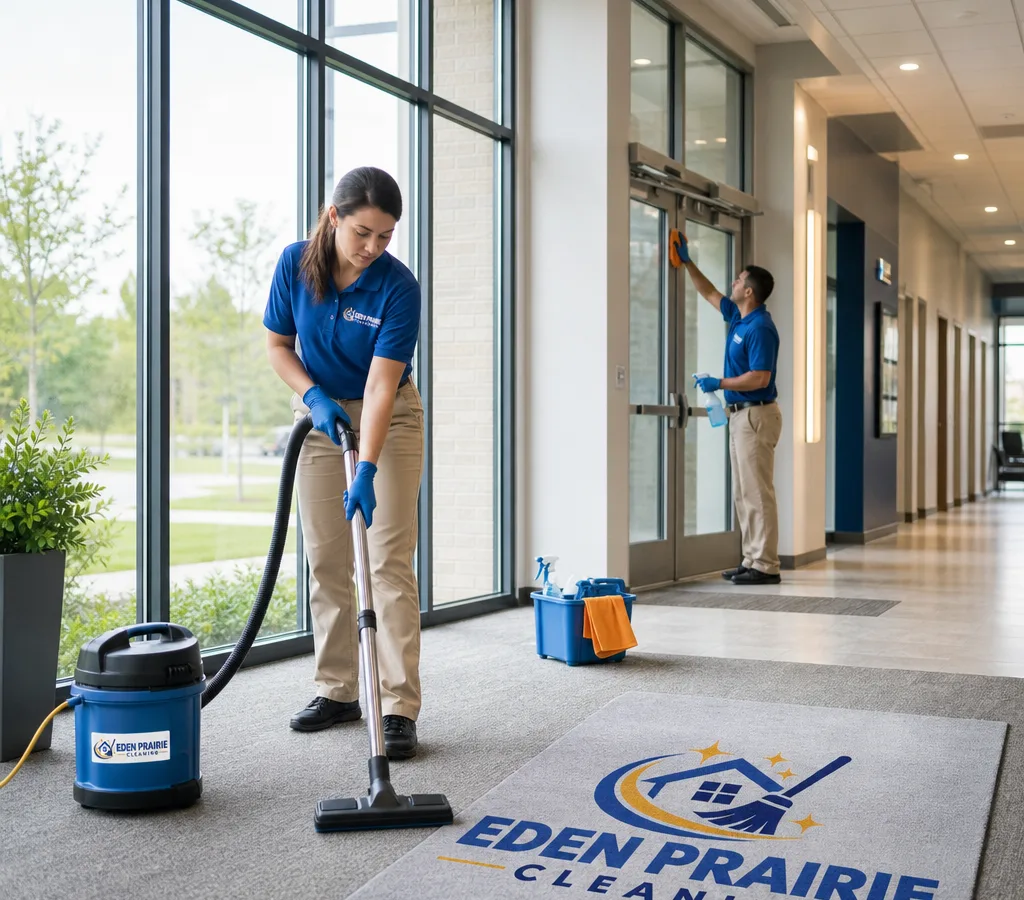
Two uniformed Eden Prairie Cleaning staff reviewing a checklist and supplies

Schools, daycares, preschools

School & Daycare Cleaning, Eden Prairie

A building full of children sets the rules: cleaning happens when they are gone, with methods that leave no smell, and the surfaces they touch most get the most attention.

✓Written scopes ✓Documented tasks ✓Flexible scheduling ✓Ongoing quality checks

Child-occupied space first

Cleaning a building that children occupy all day

Children change every assumption. Surfaces get touched at knee height as well as hand height, tables are shared by groups all day, floors take food and craft materials, and anything with a strong smell is a complaint waiting to arrive from a parent or a teacher the next morning.

Timing is not flexible either. Work happens after dismissal or before arrival, and in a daycare with extended hours that window can be short and firmly fixed. A crew that overruns into the first drop-off is a safeguarding problem rather than a scheduling inconvenience.

  • Consistency: the same scope, the same standards, and documented tasks.
  • Practical scheduling: after-hours, early morning, or daytime touch-ups where appropriate.
  • Building-ready cleaning: methods and products suited for common office finishes like LVT, VCT, carpet tile, glass, stainless, and painted drywall.

What the building is used for shapes the scope more than its size. Classrooms, a cafeteria or snack area, restrooms built for small users, nap and quiet rooms, and a gym or activity space each soil differently and need their own frequency. A single checklist across all of them always shortchanges the restrooms.

For a broader look at what we do across properties beyond office spaces, review our cleaning services in Eden Prairie.

Child-occupied space first

Cleaning a building that children occupy all day

Shared tables and chairs between groups

Tabletops, edges and undersides, chair seats and backs, and the tray or cubby surfaces children handle constantly. These get a defined pass every visit, because a shared table is the single highest-contact surface in any room in the building.

Restrooms built for small users

Low fixtures mean hand contact at floor and wall level, so the work extends well past the fixture itself: the wall behind and beside, the floor to the wall junction, stall partitions at child height, and dispensers checked on every visit without exception.

Methods that leave no smell behind

Strong fragrance in a child-occupied building is a complaint and sometimes a health issue. We work with low-odor products, ventilate while we work, and time any heavier task so the room has hours to air before children return to it.

Floors under the activity, not around it

Classroom and activity floors take food, paint, sand, glue, and whatever came in on boots. Carpet needs edge and corner work rather than a center pass, and hard floors need the strip along the baseboard and under tables where the debris actually settles.

Illness season surface focus

Through the respiratory months the touch-surface list becomes the priority: door levers and push plates, light switches, handrails at child height, table edges, cubby handles, and shared equipment, covered more often rather than more aggressively.

Nap rooms, cots, and soft surfaces

Cot and mat frames, the floor beneath them, and the storage they live in, on the cycle your licensing arrangements and your own policy set. Fabric and bedding stay with your staff, since laundry handling belongs inside your own procedures.

The school year and the season

Minnesota winters and the school calendar both bite

Snow boots, snow pants, and five months of salt arrive in an entry built for fifty children at once, and the grit goes everywhere from there. Entries and the corridors leading off them need far more frequency through the winter, and the mudroom or cubby area becomes the hardest-working space in the building.

The calendar gives you the only real opportunity for heavy work. Breaks and the summer gap are when floors can be stripped and refinished, carpets can be done properly, and a whole-building reset is possible, because nothing of that scale fits into the hours between dismissal and the next morning.

We build your scope around how people move through the space:

  • Entry points: where dirt actually comes in, and what flooring is there.
  • Restroom utilization: number of stalls, number of users, and peak times.
  • Conference rooms: turnover frequency and reset needs.
  • Waste streams: landfill, recycling, and any special handling your building requires.

If you need Janitorial Eden Prairie service that stays consistent, the biggest improvement usually comes from tightening the scope so every cleaner knows exactly what “done” means for your suite.

Technician cleaning commercial entry matting and a lobby floor affected by winter salt

Setting up in your building

How we set up a school or daycare

  1. 01

    Work from your licensing and your policy

    We ask what your licensing arrangements and your own policies require of a contractor: background expectations, which rooms we may enter, product restrictions, and documentation. That shapes the scope before anything else does.

  2. 02

    Map the rooms by how they are used

    Classrooms, infant and toddler rooms, snack or cafeteria space, restrooms, nap areas, offices, and activity space, each with its own task list and frequency. Fixture counts and floor types get recorded on the same walk.

  3. 03

    Lock the window around arrival and dismissal

    A fixed arrival time after the last child leaves and a hard finish before the first arrives. We agree who is in the building during the visit, how we get in, and what happens on an early-release or extended-care day.

  4. 04

    Plan break work on the academic calendar

    Floor refinishing, carpet work, and whole-room resets get placed on breaks and the summer gap, scheduled months ahead. That calendar gets written down so it is not competing with your own maintenance plans.

What a school quote reflects

How Much Does School Cleaning Cost in Eden Prairie?

Pricing follows the number of rooms and how they are used, restroom fixture count rather than room count, enrollment, the flooring mix, how many days a week you need service, and the length of the window between dismissal and arrival. Break-period work such as floor refinishing is quoted separately on the academic calendar. We quote after walking the building with your own requirements in hand.

Final pricing depends on square footage, number of restrooms, floor types such as carpet versus hard surface, breakroom needs, after-hours access requirements, and how much detail work you want each visit. Exact cost is confirmed after a walkthrough and written scope.

Questions from principals

Principals and directors ask about these

What do you require of staff who work in a building with children?+

We work to whatever your licensing arrangements and your own policy require, and we will tell you plainly what we can meet rather than claiming a credential. Send us your contractor requirements in writing: screening expectations, entry rules, supervision, and documentation. If something on that list is beyond what we provide, you will hear that before you sign, not after.

A parent complained about cleaning smells last year. How is that avoided?+

Low-odor product selection, ventilation while we work, and timing. Anything with a noticeable scent goes into a room with hours of air time before children return, and routine daily work uses products chosen for low fragrance in the first place. If a specific sensitivity exists in your building, tell us and we will work from a restricted list.

Our window after dismissal is only two hours. Is that enough?+

It depends on what fits in it, and the honest answer comes from the walkthrough rather than from a brochure. A short window usually means a daily core scope (restrooms, tables, floors, waste, touch surfaces) with everything heavier moved to a weekly rotation and the biggest tasks to breaks. We would rather tell you what does not fit than quietly skip it.

Who is responsible when a child is sick in a classroom?+

Your staff, immediately, because it happens during the day and cannot wait for an evening visit. Your own procedures cover that response. What we do is the follow-up on the next visit: the floor and surrounding surfaces properly cleaned, waste handled as ordinary waste, and the area given attention beyond the normal routine.

Can floors be refinished without closing the building?+

Not realistically, which is why the academic calendar matters so much. Stripping and refinishing needs clear rooms, ventilation, and drying time measured in hours rather than minutes. Winter and spring breaks handle a wing or a floor; the summer gap handles the whole building. Planning it a term ahead is what keeps it from being rushed.

Is a daycare really different from a school?+

Yes, in three ways that change the scope. The hours are longer so the window is tighter, the surfaces are lower so cleaning reaches floor and wall level that a school does not, and nap and infant areas add rooms with their own rules. A daycare also typically needs more restroom frequency per child than a school of the same size.

Talk about your building

Need the building ready before drop-off?

Send us your room count, your enrollment, your contractor requirements, and the exact window after dismissal. We will walk the building, tell you honestly what fits in those hours, and put the heavy work on your calendar.

Request a quote

Tell us about your space

Send the details and we will come back with a written scope and a clear plan.