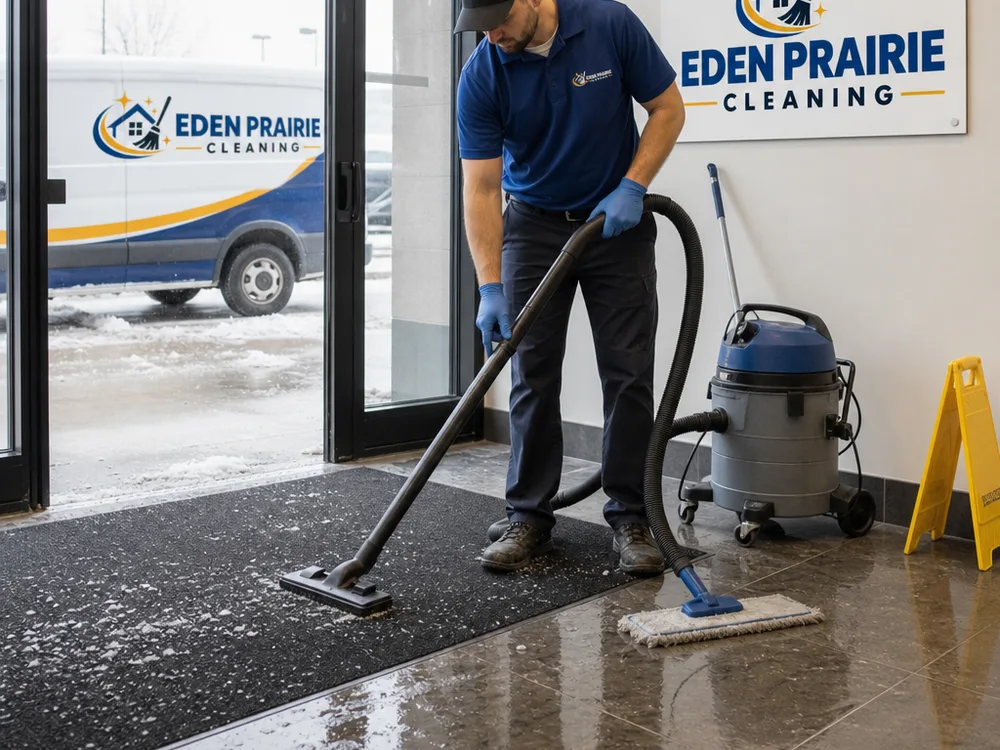
Technician cleaning commercial entry matting and a lobby floor affected by winter salt

Post-construction cleanup in Eden Prairie

Post-Construction & Renovation Cleanup

Construction dust does not stay where you left it. We clean in staged passes, let the air settle between them, and keep going until surfaces stop coming up gray.

✓Written scopes ✓Documented tasks ✓Flexible scheduling ✓Ongoing quality checks

Dust after the work is done

Why renovation cleanup takes more than one pass

Fine dust behaves like a liquid with a delay. Sanding drywall, cutting tile, and running a saw indoors loads the air with particles that keep landing for days, which is why a single wipe down can look finished at six in the evening and read gray again the next morning on the same countertop.

So the work is sequenced rather than scrubbed harder. Heavy debris and loose dust come out first, then surfaces get detailed from the ceiling plane down, then we return after the air has settled and repeat on what matters most. Registers and filters get attention too, because forced air redistributes whatever is still in the system.

  • Consistency: the same scope, the same standards, and documented tasks.
  • Practical scheduling: after-hours, early morning, or daytime touch-ups where appropriate.
  • Building-ready cleaning: methods and products suited for common office finishes like LVT, VCT, carpet tile, glass, stainless, and painted drywall.

Two different jobs share this name. A contractor needs the space presentable for a punch walk or a final inspection, with protective film pulled, labels off, and fixtures detailed. A homeowner living beside a remodel needs the dust out of the rooms the project was never supposed to reach.

For a broader look at what we do across properties beyond office spaces, review our cleaning services in Eden Prairie.

Dust after the work is done

Why renovation cleanup takes more than one pass

Debris and packaging gathered first

Offcuts, packaging, protective materials, and loose debris collected and staged where you want it, whether that is a container on site or a pickup point. Removal from the property depends on what you have arranged, and we confirm that before the day.

Ceiling plane down, in that order

Fans, light fixtures, the tops of doors and casings, ledges, and upper cabinets before anything at waist height. Working downward means the dust we disturb lands on surfaces we have not cleaned yet instead of the ones we just finished.

Registers, returns, and filters

Supply registers and return grilles get cleaned, and accessible filters are replaced when you supply them. Skipping this is the most common reason dust reappears for weeks: the system holds a reservoir and pushes it back out on the next cycle.

Inside cabinets, drawers, and closets

New cabinet boxes, drawer interiors, closet shelves, and pantry shelving collect a fine layer that is invisible until something is set on it. These are cleaned individually, before counters and floors, so the dust has somewhere to go but out.

Film, labels, adhesive, and overspray

Protective film on windows, appliances, and fixtures, manufacturer labels, adhesive residue, paint flecks, and joint compound spots on glass and hardware. Each surface gets a method that suits its finish, tested somewhere out of sight first.

New glass, tracks, and fixtures detailed

Fresh windows and doors hold dust and compound in the tracks and a film on the glass that ordinary washing smears. Tracks get cleared, glass detailed to the edges, and new plumbing and lighting fixtures cleaned without marking the finish.

Where the dust hides

The places construction dust settles and waits

The obvious surfaces get cleaned by everyone. What gets missed is upward facing and out of sight: the tops of door casings and cabinets, light fixture bowls, closet shelves, stair tread nosings, window tracks, the back of new drawer boxes, and the ledge above a baseboard heater. Those are the reservoirs that refill a room days later.

Minnesota timing adds to it. A remodel through the heating season runs the furnace in a dusty house, carrying particles past plastic sheeting into rooms nobody worked in. A summer project with doors propped open mixes yard grit and pollen into the same drywall dust, which changes how it wipes and how often.

We build your scope around how people move through the space:

  • Entry points: where dirt actually comes in, and what flooring is there.
  • Restroom utilization: number of stalls, number of users, and peak times.
  • Conference rooms: turnover frequency and reset needs.
  • Waste streams: landfill, recycling, and any special handling your building requires.

If you need Janitorial Eden Prairie service that stays consistent, the biggest improvement usually comes from tightening the scope so every cleaner knows exactly what “done” means for your suite.

Two uniformed Eden Prairie Cleaning staff reviewing a checklist and supplies

How the cleanup runs

How we run a construction cleanup

  1. 01

    Confirm what is finished and what is not

    If a trade is coming back to sand, caulk, or touch up paint, cleaning before that is wasted money. We check the schedule with you or the contractor and sequence our passes around the work that is genuinely done.

  2. 02

    Clear loose debris and gross dust

    Debris staged, floors and horizontal surfaces taken down from heavy to light, and the worst of the airborne load removed before any detail work starts. This pass is about volume rather than finish quality.

  3. 03

    Detail from the ceiling plane downward

    High surfaces, fixtures, cabinet and closet interiors, trim, glass, then counters, then floors last in each space. Cloths and water get changed often, because drywall dust turns a damp cloth into a tool for spreading it.

  4. 04

    Return pass once the air has settled

    A second pass on the surfaces that matter, scheduled after the dust still suspended has had time to land. For a punch walk we time that pass as close to the inspection as your schedule allows.

What drives the estimate

How Much Does Post-Construction Cleaning Cost in Eden Prairie?

The cost follows how much dust was made and how far it traveled. The factors are affected area, which trades were involved and how much sanding happened, whether containment was used during the work, debris volume, how many passes the space needs, the count of new kitchens, baths, and fixtures to detail, ceiling height and access, and the inspection date. We quote after walking the space.

Final pricing depends on square footage, number of restrooms, floor types such as carpet versus hard surface, breakroom needs, after-hours access requirements, and how much detail work you want each visit. Exact cost is confirmed after a walkthrough and written scope.

Dust questions, answered

Contractors and remodeling homeowners ask about dust

When should cleaners come in relative to the trades?+

After the last dust producing trade has finished, not before. Paint touch up, caulking, and any further sanding all undo a finished clean, so the usual sequence is a rough clear out when the heavy work ends, then the detail passes once the final trade is out. Tell us the real schedule and we will plan to it rather than clean twice.

A general contractor needs the unit ready for a punch walk. How fast?+

That depends on the area, the dust load, and how many passes it needs, which is what the walkthrough determines. What we will not do is promise a finish time that forces a single pass on a space that needs two, because the inspection is exactly when settled dust shows. Give us the date and we will tell you plainly if it is workable.

We lived here through the remodel and dust got everywhere. Where does it stop?+

At a boundary you set. A whole house pass is a bigger job than cleaning the renovated rooms, so we scope it as the work area plus the rooms the dust actually traveled to, usually along the path of the forced air system. Registers in those rooms matter as much as the surfaces, or the dust keeps returning.

Do you haul the debris away?+

We gather and stage debris where you want it, and whether it leaves the property depends on what has been arranged. If there is a container on site we load to it. If not, the contractor or homeowner usually handles disposal, and we agree that before the day rather than leaving a pile in a driveway nobody owns.

Why would one cleaning not be enough?+

Because the dust is still in the air when the first clean finishes. Particles fine enough to stay suspended keep landing for a day or more, so even careful work gets a new film on top of it. A staged approach with a return pass costs less than being called back to clean a space that already looked finished once.

Can the HVAC system be cleaned as part of this?+

We clean supply registers and return grilles, and we replace accessible filters when you provide them, which handles the part of the system doing most of the redistributing. Cleaning inside the ductwork itself is a separate trade with its own equipment, and after heavy sanding without containment it is worth asking one of them to look.

Book the cleanup

Need the dust gone before the final walk?

Send us the project scope, the affected area, and the inspection or move in date. We will walk the space, tell you how many passes it needs, and build the schedule backward from your date.

Request a quote

Tell us about your space

Send the details and we will come back with a written scope and a clear plan.